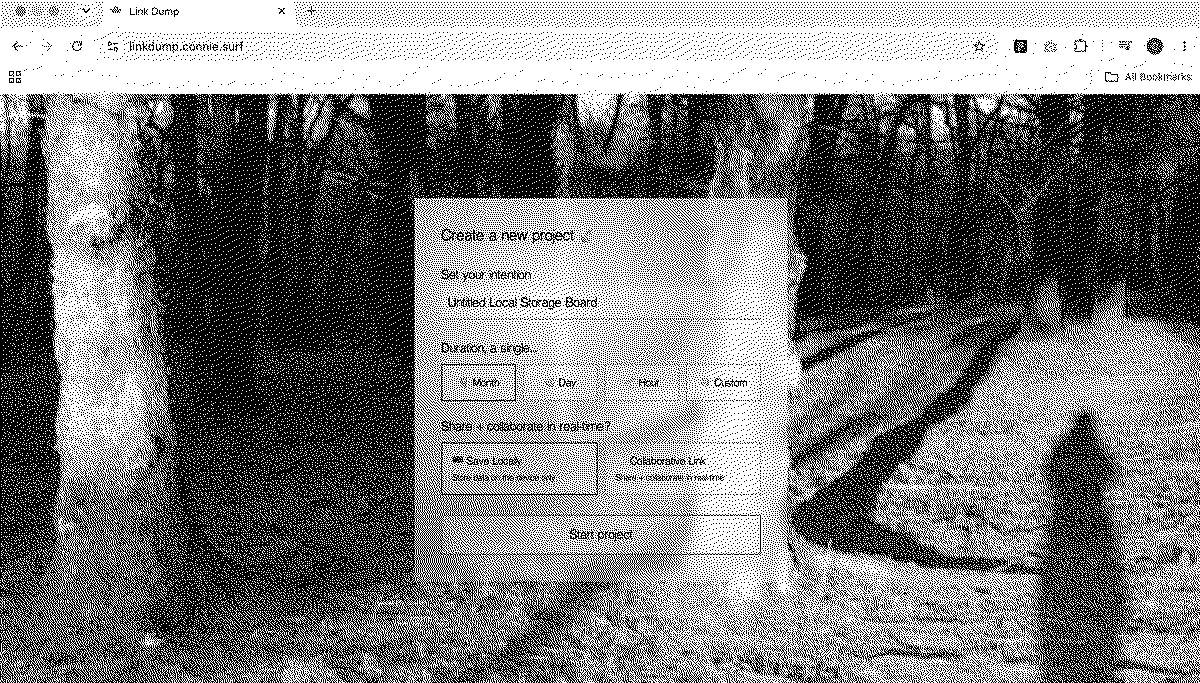
What is Link Dump?
Link Dump is an ephemeral canvas that allows you to map and organize text notes, images, and links spatially into sections. You can add media to the canvas manually over time, through the Chrome extension or by importing links from Are.na. Think of it as a place for you to process your references and notes into cohesive form, with the emphasis on time as an impetus for processing.
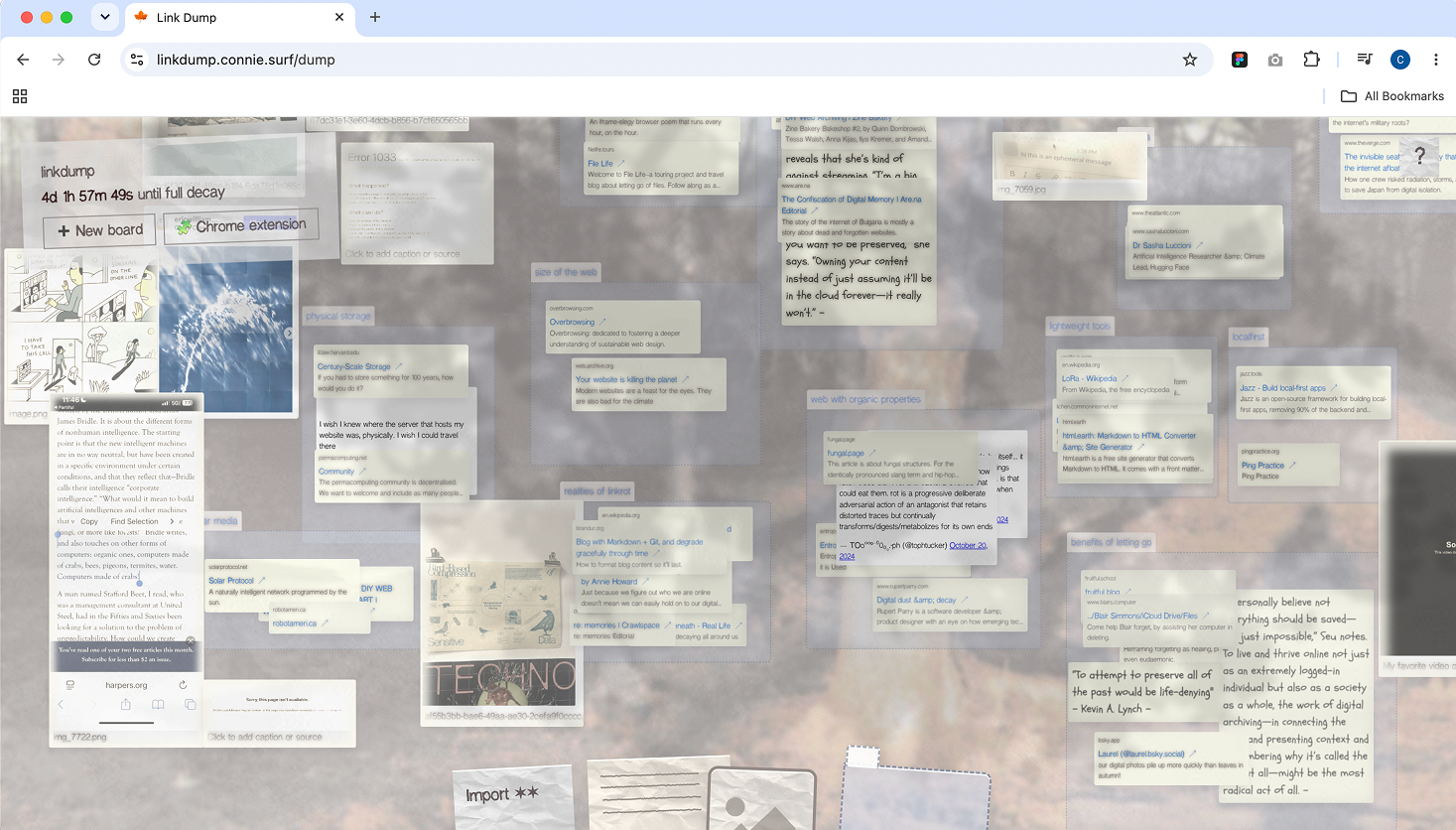
The canvas is only active for a user-defined period. As time passes, the content slowly decays and becomes unreadable. At the end of the period, users can export their data locally as a CSV but the canvas is no longer usable.
Why did you make it?
For the longest time, it felt like I would spend weeks and months collecting references and ideas only to let them wither away in my Are.na channel. I thought if I made a time-bound board I would be more aware of the passage of time and act on my ideas. Creating is a transformative and temporal act, it's a way to release ideas from our current self into the world, so I felt like it was important to work on my ideas the moment they appeared.
The other reason was because I was interested in this idea of the "organic web", one that paralleled the internet to natural cycles more closely. As time goes on, I'm surprised by how internet memory operates in absolutes. I’ve always taken it for granted the internet’s perfect memory, my past self preserved in years of messages and social media posts. In recent times I’ve started to understand its sudden precarity, for example, Read.cv, a social network for designers, disappeared after acquisition. Data then exists in artificial timelessness, one that doesn’t force us to reflect.
I personally don't think the default mode should be to remember so much, the internet gets heavier by day and has impacts on the physical world. We build more data centers and subsequently the air conditioners and power grids to keep them running. The data, depending where it is, gets used to further optimize our lives.
Besides, the beauty of transience is that it makes you reflect on what's worth keeping.
Tell me more about “the beauty of transience”. How does it come to play? And how does it relate to the temporal act of creating?
The core of life is transience, nothing lasts forever; the seasons, people, thoughts, feelings, the world, everything changes. Although scary, I find transience rooted in optimism. As much as times can get worse, they can get better, the past is a tapestry of those moments.
I think creating is most honest as a temporal act where we look at the past as our present selves, understand it, and become changed.
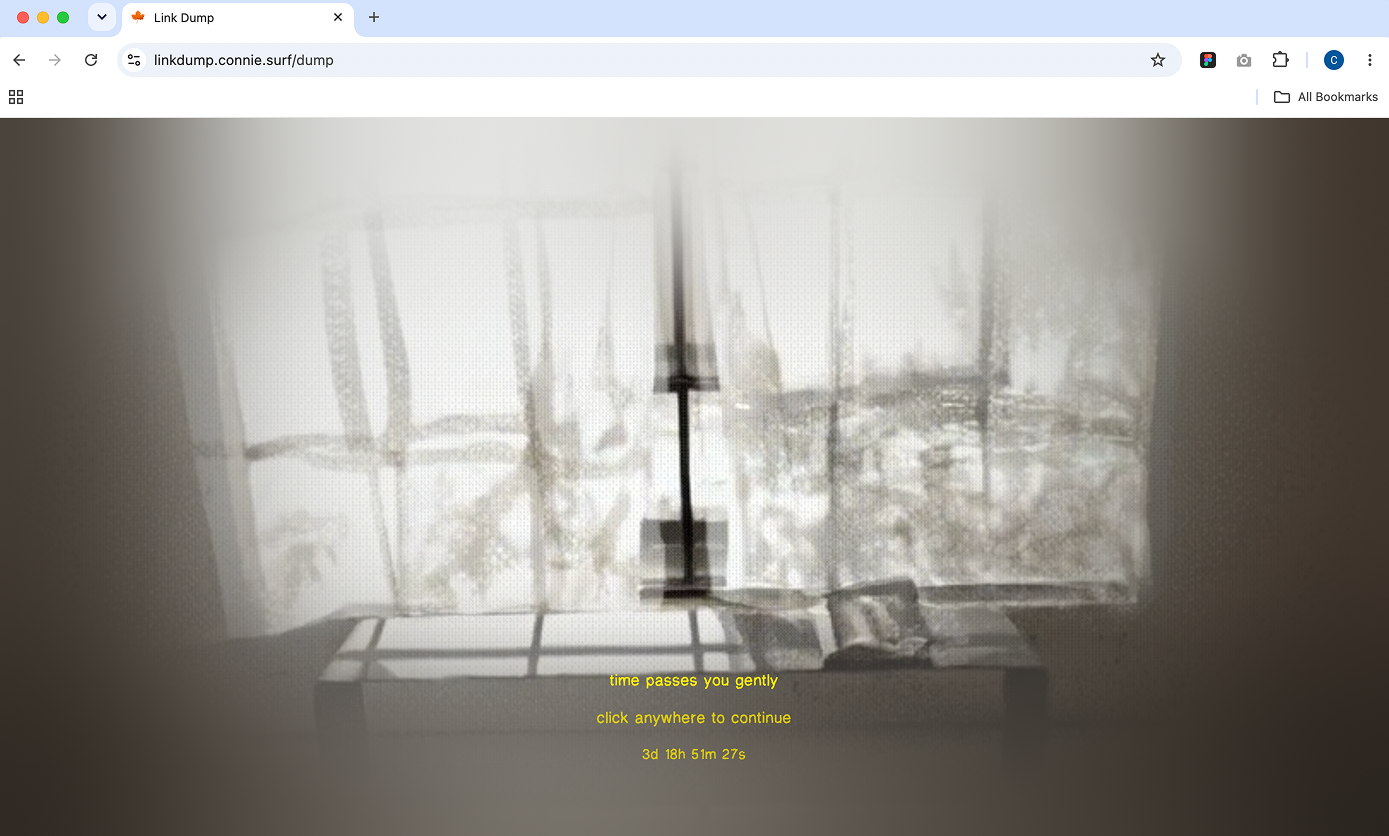
To me the canvas has a nice collage feeling. It’s almost like using magnets to decorate my fridge. What kinda canvas have you made for yourself? Or do you have some examples of what other people made?
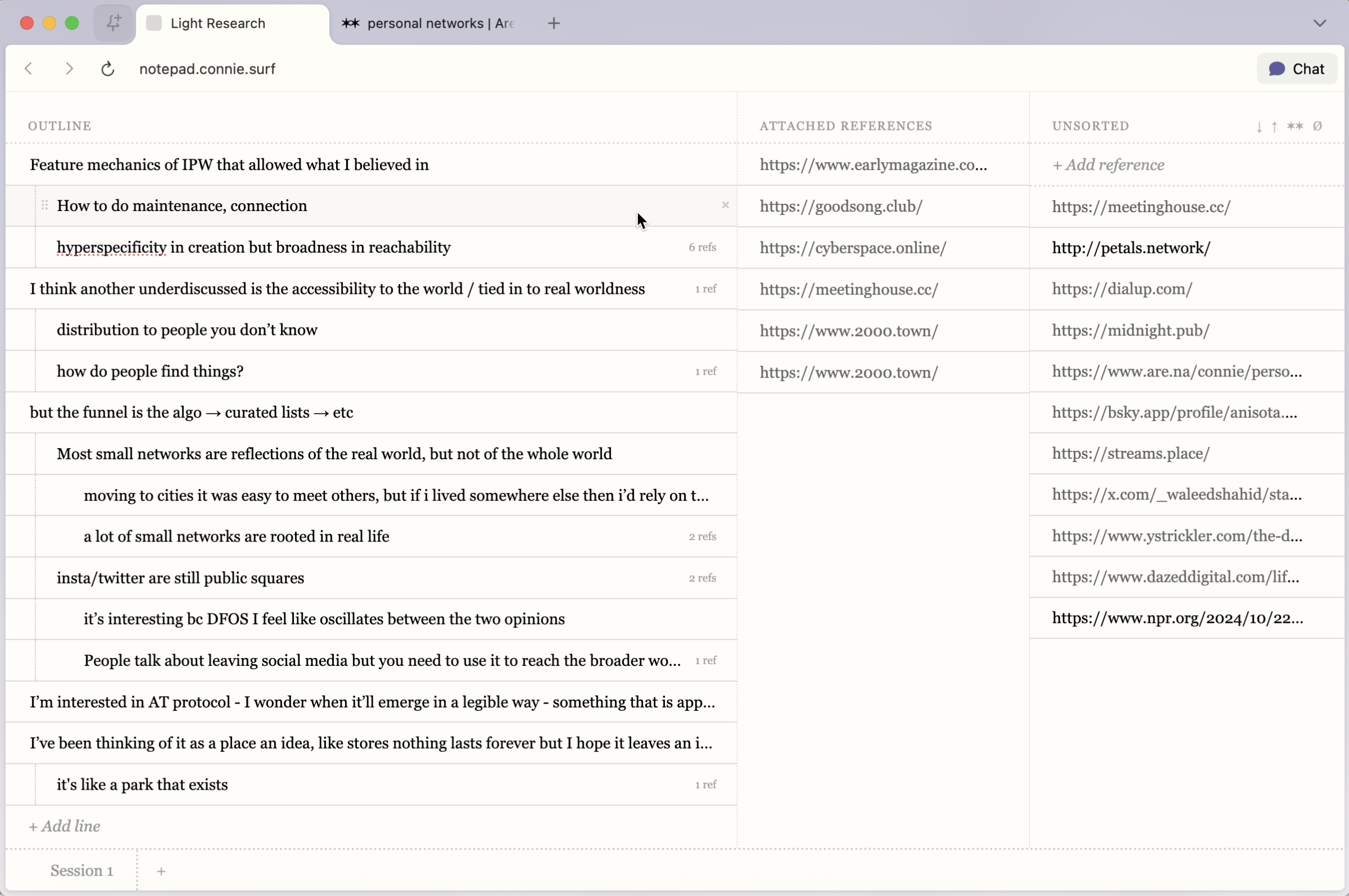
My biggest canvas project was Link Dump, but I also made this project called Light Research where you could plot references on several axes as a simpler way of categorizing. The canvas is hard to share since its function is to be freeform, but that form factor is the best when you’re trying to map out what you want to do in high fluidity. Other examples - kinopio.club, world of text, and FigJam (although this isn’t an indie tool). I would say the focus of Link Dump is less about annotating or complex connecting, but rather simply sorting and distilling patterns from your pings.
For example I’ve used Link Dump to organize the links in this are.na channel I have called the “organic web” into several subthemes such as permacomputing and websites that decay. I was then able to display these structured groups of references in an essay I wrote about Link Dump (https://decay.connie.surf/). As you scroll over specific paragraphs of the essay, these groups of links will reveal themselves.
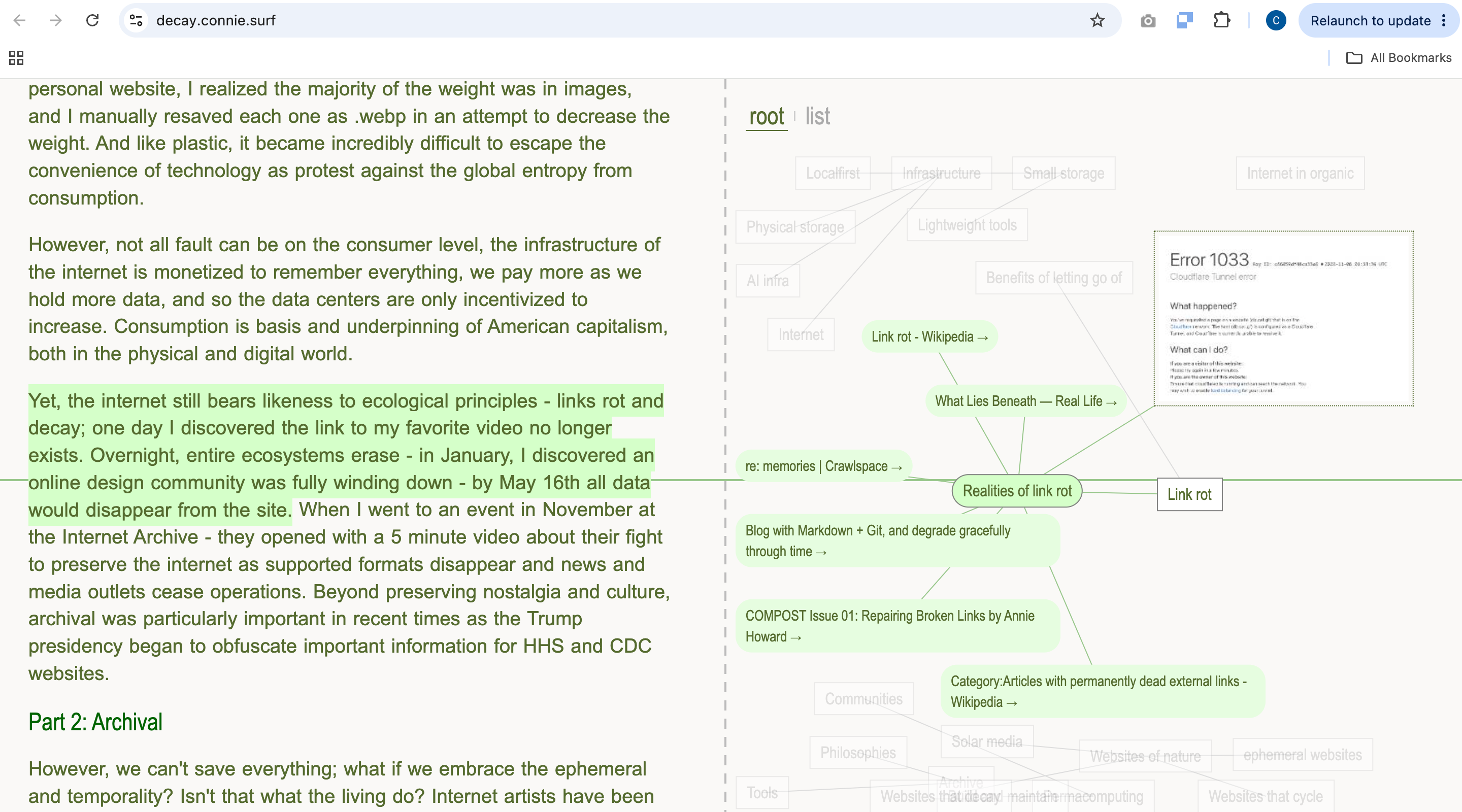
You mentioned the canvas can be exported to a .csv file. Do you export your own canvases? Or do you let them decay?
Because everything lasts forever on the internet, I’ve really still relied on the cloud. But for systems that are finite, like my phone storage, I’ve taken to a practice where I’ll delete photos from my camera roll on long flights. It’s that practice of remembering and discarding that sparked my interest in temporality and digital life.
Who or what inspired you?
I've always been interested in temporal art projects such as Laurel Schwulst's The Life and Death of an Internet Onion, Elliott Cost's File Life, and Everest Pipkin's Anonymous Animal. Beyond that, Low Tech Magazine is a wonderful resource on understanding what a lighter weight web could look like. I also am a fan of compost.party, which was a website powered by a solar powered refurbished smartphone. It’s interesting to note that some of these projects are hard to find as their domain has gone offline, further showing the importance of archival…
Finally there's a Rick Rubin quote that says the following about acting on creative inspirations within time
“Think of the universe as an eternal creative unfolding. Trees blossom. Cells replicate. Rivers forge new tributaries. The world pulses with productive energy, and everything that exists on this planet is driven by that energy. Every manifestation of this unfolding is doing its own work on behalf of the universe, each in its own way, true to its own creative impulse.”
All these links eventually led me to ask the question - what if we made a lighter weight web through using time? And so, Link Dump was my answer.
Is that why you called it Link Dump rather than Link Museum? To lower the barrier for creation?
I think the act of collecting is very lightweight but actually sorting and processing can feel heavy. I was considering “decomposition notebook” for a period of time, but I liked the casualness of link dump. The beginning process of formalizing your thoughts and ideas is a messy, but fun act, like raking the fall leaves and jumping on them.