Kristoffer Tjalve: What is Zig~Zag?
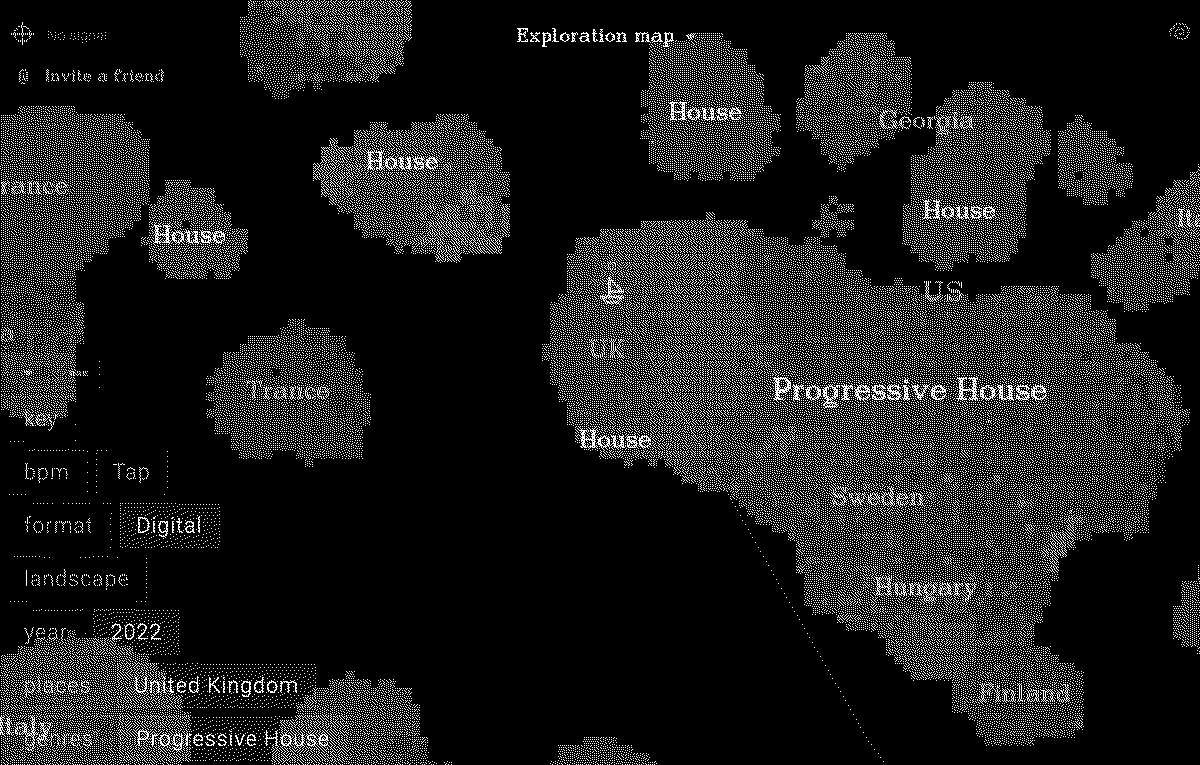
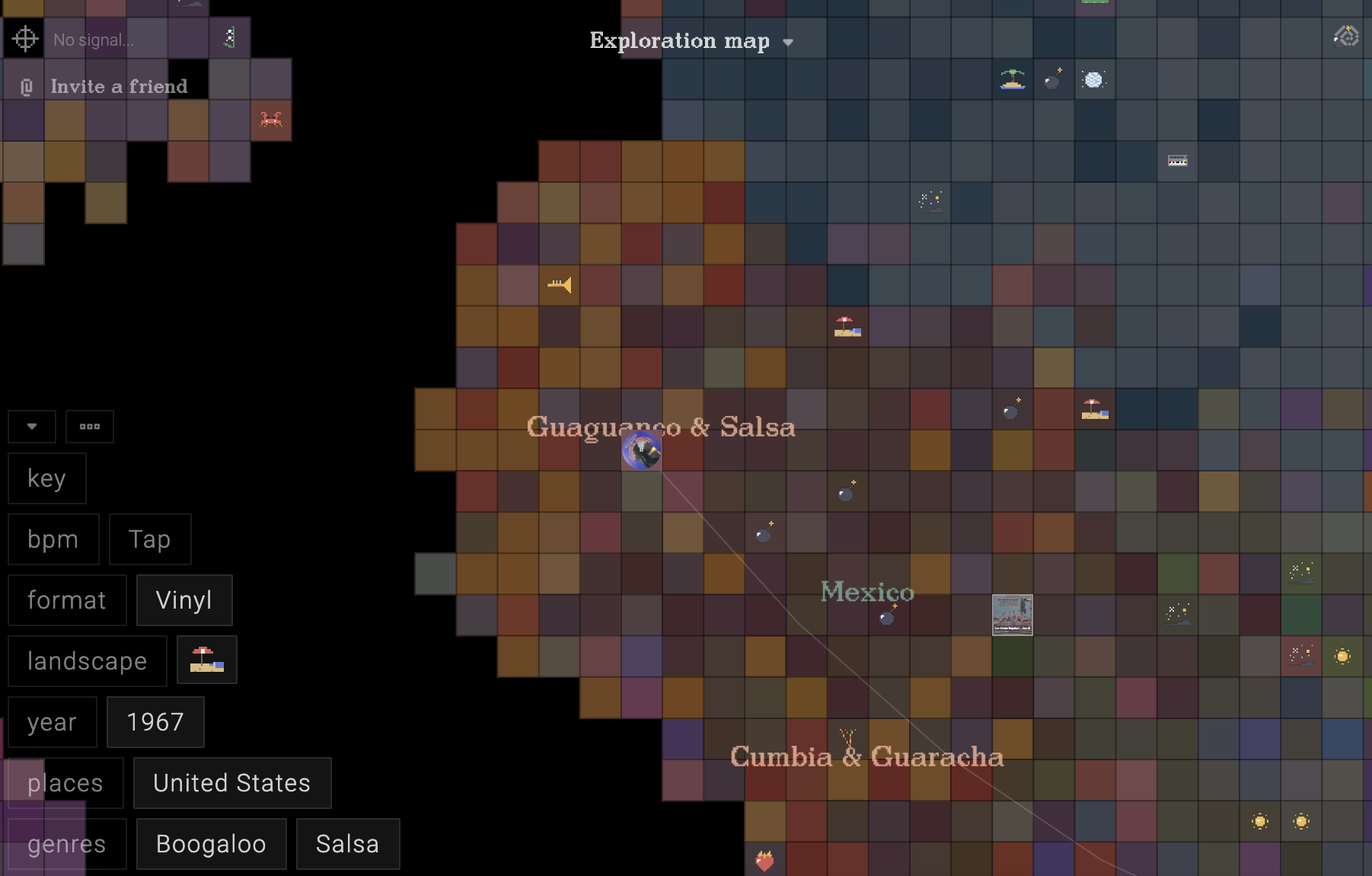
Antonin Wattel: Even me, I'm not sure I know how to explain it well. I would say it's kind of a web space for exploring music in a non-linear way. That's why it's called Zig~Zag. The idea is that we map quite a big catalogue of music, mostly extracted from Discogs's public data, and make it an abstract map in 2D in which every pixel is an album that you can click and listen to. And you are navigating the space with a little boat of yours, and you can sail around, get lost, fall through different rabbit holes of music. And also now there's kind of a more social dimension coming to it. So you can also meet friends there, that you know in real life, or that you don't know, and have boat parties with them.
The map feels like an archipelago of musical islands. And, as you say, I’m kind of a little boat, sailing between these islands, and then within the islands, there are smaller tiles, almost like a spreadsheet or Civilization or Catan-styled game, where each tile becomes music I can discover. How did the nautical theme emerge?
I don't know, it's funny because we didn't really decide actually. It kind of came naturally. The first idea was a map where each pixel is an album, and nearby pixels represent music connected by genre, subgenre, family or other features. So we had this map, this ocean, so we needed a boat to explore the ocean, and then I was kind of struggling to find a logo, and I was digging through, whatever, pixel art and stuff, and I saw this little boat, and I was like, that makes sense. A pixel boat with a little wave below, and then from there, all the lore, the aquatic and boat lore kind of evolved in a natural way, I would say.
So you didn't really consider alternatives? It could not be a forest, or a village, or…
It could have been space, maybe, but I think the boat is more poetic than the rocket.
I like it. It reminds me of the 90s web with all these explorative metaphors, like Internet Explorer, Safari, and Netscape. It’s kind of a nostalgic hint to an earlier web.
Yeah, definitely, and a lot of people are saying that it's very refreshing to have this kind of nostalgia of an earlier web that is more naive, in a way. And I completely agree. I wish I knew more of this web, actually, because I'm 25, so it's not super crisp in my mind how the web was in the past.
When I'm sailing around from these islands, listening to music, I really feel empowered, I really feel like it's up to me to kind of figure out what I want to do, and as a consequence, I find myself exploring much more and listening to other music than I otherwise would do, which is, like, a long time since I've done that. How deliberately did you design Zig~Zag for active discovery rather than passive listening?
Yeah. I mean, thanks. I would say the site is actually built for discovery, and that's how we always have imagined it. It was also born from some kind of frustration, I have to say, with all the big platforms, and the way algorithms are built in recommendation today. We're all kind of diggers, or wannabe DJs, whatever, at heart, so we're frustrated by algorithms like Spotify's that keep serving us the same tracks, and you can't really deviate from what you're used to. So yeah, this was really the intention. We really designed it for us, so it was pretty intuitive that it was kind of a discovery tool, but it could also be a radio or listening tool.
You also show metadata like genre, year and country alongside the music. I got into some Canadian, like, 80s music, and I was like, okay, this is really interesting, I want to hear more of this.
I mean, yeah, for sure, there's really this choice of providing quite a lot of information, with the aim of being able to deviate and fall into different rabbit holes. You can explore the map, or follow an artist, label or year through the filters. That's definitely an important choice for more discovery, and also, at the same time, to try to provide a space with more friction in the digging and in the research than traditional platforms. But at the same time, kind of more fluid than the old-school way of digging, which I also love, and it's also a super fun thing to do, but if you're digging on Bandcamp or Discogs or whatever, for example, you end up with, like, 100 tabs open, and you're lost and stuff.
Would you say that you give more friction than traditional platforms?
Yeah, maybe friction is not the right term, but at least more intention. And a more active way of digging. But I'm saying that because that's also how I use it a lot, but a lot of people turned out to be using it also as a radio and just letting stuff go and using our recommendation algorithm, which is also a nice way, and it's pretty different, so it's also refreshing, I guess.
Sometimes I leave Zig~Zag playing in a tab and return when something catches my ear. Then I can see the genre, country and year, which also gives me a sort of educational element that I don't really get from other platforms. You show some metadata that is often hidden, and I feel more informed afterwards. It feels more like handling a physical record than passively streaming.
Amazing. But yeah, we also do have recommendation algorithms, it's just that they're not tuned in the same way as some others are. We're not interested in a record's popularity or view count. It's also about rediscovering music that has been overlooked or lost. It’s in a way some kind of archival and revival practice of music. Music that is sometimes not even on the platforms. And also this idea of a 2D map is to just put everything on the same level, no matter the popularity.
This is a nice segue into how it's made. Most of the data come from Discogs?
I don't know if you know about Discogs, but it's a pretty huge platform, which is actually a marketplace for physical music, so vinyls, records, cassettes, whatever. And it's been up for a really long time, and it's very nice because they publish their data publicly. It's a very rich source of data which is also quite interesting because it's about physical music. People have a different relationship to music when it's on a physical object, when it's on a record, compared to streaming services, for example, maybe they're more attached to it. And there's also this data of people who buy stuff, people who collect stuff, and it's super nice to actually analyze and make something out of it. And even if Zig-Zag is really, of course, an online platform, we're also kind of attached to the real world and to actual record shops, you know, that's a pretty important thing we feel. A few months ago, we actually were knocking on record stores and we were like, “yeah, we have this thing. If you have Discogs, if you want, you can have your little island on Zig-Zag.” And there's also this idea of, of course, to find a way, find a sustainable model. We're not there yet, of course, but we would like to find a model that would help artists in a better way. We try to always provide links to Bandcamps, to Discogs, to actually buy their music. We feel it's important. We'll see how that evolves. Hope that works.
In the FAQ, you describe Zig~Zag as a discovery platform rather than a streaming platform. And it is really how you want to integrate closer with the record stores as sort of a core part of the model, instead of kind of seeing them as your competitors. Many internet platforms have tried to replace physical spaces. Why is supporting record stores important to Zig~Zag?
Because a lot of record stores, it's not an easy job, like, a lot of them are kind of struggling. We are actually trying to help them.
So the data comes from Discogs, and then you kind of map it out, similar to Every Noise at Once. But how is the map actually created? Like, how are all the islands formed?
Yeah, so that's actually a really… so many steps to it, and…
[laughs]
A lot of, I would say, magical potion cooking,
Of course, there's always a secret involved.
Basically, there's different steps to it, so we take the data, clean it, whatever. Moritz will probably talk about it better, because he's the very wizard data guy. But so, we take the data, and for each album, there's a bunch of features to it. So the genre, the subgenre, the year, the artist, but also, I don't know, the sound engineer, the guy who made the cover, but also on Discogs, the people who collected this track, people who put it in collections with other tracks.
Machine-learning techniques map millions of albums into a 16-dimensional space, grouping them by shared features. And then the idea is to reduce the dimensionality again to make it 2D. And of course this is like an impossible exercise because you lose information for sure. And there are choices to make, obviously. So going from these 16 dimensions to two dimensions is half manual and half algorithmic. There's a quite important, I would say, bias towards families and genres of music, which of course are kind of weird classifications, but somewhat still kind of make sense and help people to actually find their way. Discogs has its own big families and subfamilies classification. For example, in house you can find a Balearic house, a tech house, whatever. And so there's hundreds of these subgenres on Discogs. We kind of took the same approach, but thought about it and were like, “I would feel more like this would go there and there and there.” So there's this whole reflection about music genres and stuff.
We're not super experts or musicologists or whatever, so we do it as best as we can, but this also helps us to discover a lot of stuff. Before reducing the map to two dimensions, we give the algorithm hints about where different musical families and genres should sit. This is kind of an intuition and an impossible exercise, and of course, you have to make compromises, trying to place the music in a way that makes sense, at least to me, in terms of vibes, history, common geography, etc. So that's why you might see, for example, that the archipelago of UK electronic and bass music and breaks and dubstep and all that is going to be kind of close to the Jamaican and all the Jamaican rooted kind of music, dub, dancehall, reggae stuff. Their shared history is why those islands sit near each other. And then the algorithm does its job, taking these cues and kind of remodeling everything, and then there's some post-processing, both algorithmic and also manual, to kind of reshape it nicely, so it kind of looks like islands, and then there's some manual tweaks, and the last step is kind of like algorithmic painting, I would say.
I love the details. Your approach to recommendations reminds me of a reader's project called Radio Venus, which is basically music recommendation based on astrology. It uses musicians' birthdays and album release dates to make astrological recommendations based on your birthday. What can a music recommendation be if popularity is not the goal?
Oh, yeah, that's funny. Actually, yeah, well, for us, I mean, there's different recommendation systems and stuff. But it's basically, so this 16-dimensional space I was talking about is basically trying to find kind of similar tracks, but there's no maximization of, whatever listen time, or time spent on the platform, or popularity of artists, or we know that track is gonna be good for you, so we're gonna give it. It's actually simpler than that, and allows you to kind of have more random stuff, and probably have more luck to find hidden gems that nobody has heard for years.
You can also see other people exploring the map. How does that social layer fit into recommendations?
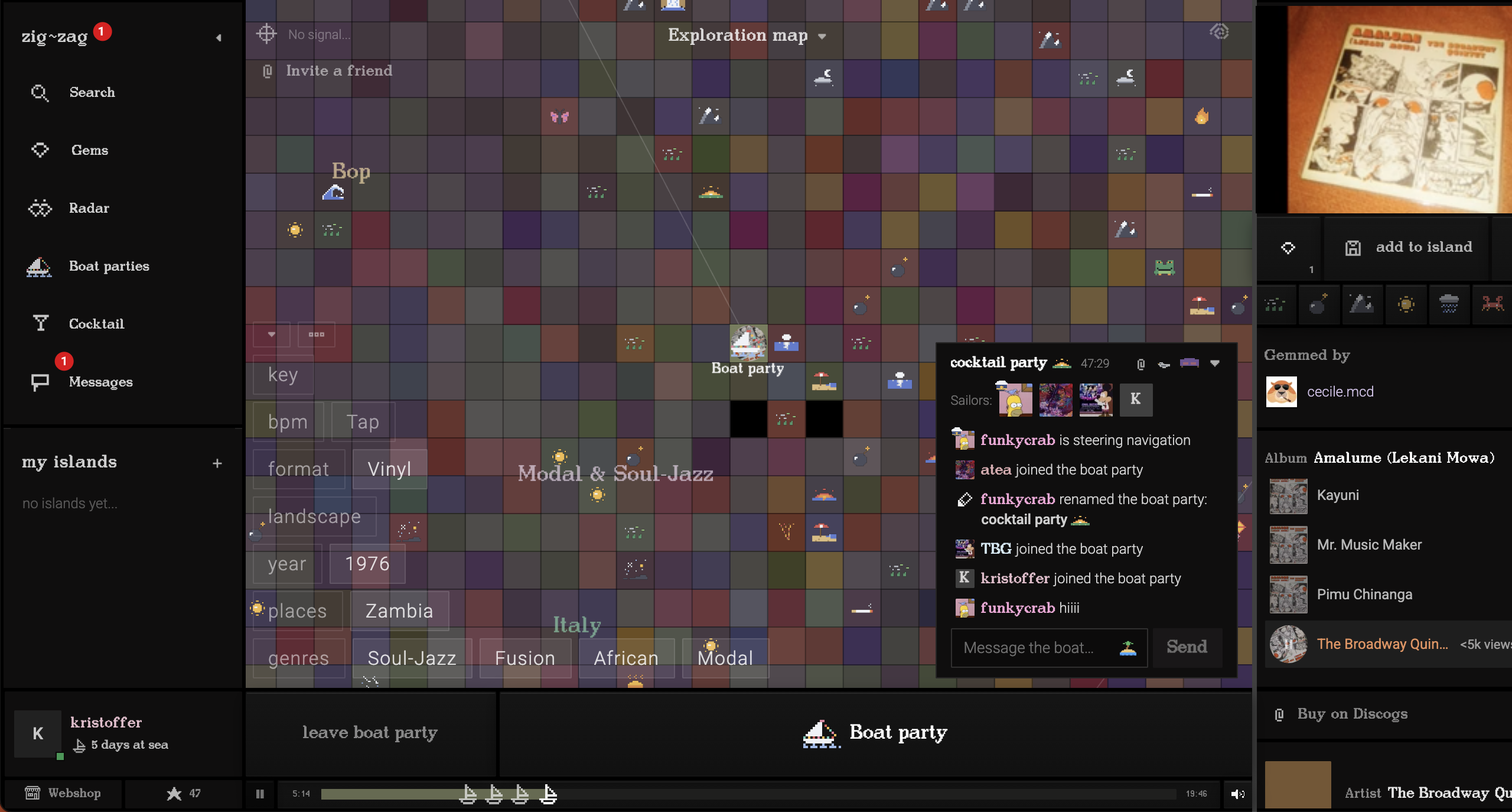
We allow people to propose recommendations on the bar to the right, so it's actually someone who is proposing the journey from this track to another, and that's kind of a very cool thing to do. But yeah, so the social thing you were saying?
Yeah, I was just wondering how this all integrates because it does feel like I'm not the only one sailing in this, like, archipelago. There are other boats, and I can see other sailors leaving certain marks, almost like a treasure hunt map, like the pirate X. How do you imagine Zig~Zag developing as a social space?
Again, it kind of happened, and not alone, but we were like, oh, that would be actually super cool to see other people that are on the map, and see their boats. That already creates kind of an interesting type of life on the website. The social side really took off when we introduced boat parties. I don't know if you've been in any of them. But the idea is that there's a captain or several captains on the boat party. And they guide the journey of sound just like a DJ pretty much. And it really works super well. So I guess that's one of the social aspects. I also designed this whole set of emojis, which really, I think, helped to make the website alive, and make people, in a way, want to express what they feel about a track or express what they feel in a boat party.
I love how the other sailors' small white boats look almost like ghost ships. It's almost a little bit haunted, and sometimes I feel like I need to get away from them, but it gives a really cute feeling to it, like there are other people kind of doing stuff, and I need to also move around and experience more.
Yeah, yeah, even me, I'm surprised. Like I reconnected with some friends that are kind of far away and we have these boat parties and even if we don't really say anything, I feel kind of a presence behind my screen in the same way I would in some video game.